








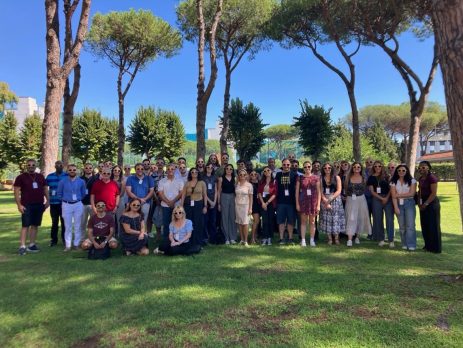
4th edition of the International Summer School SORBETTO
The 4th edition of the International Summer School SORBETTO – SOlar Radiation Based Established Techniques for aTmospheric Observations has successfully come to an end in Rome. The school took place from 14 to 18 September 2026 at the Seraphicum. The school brought together young researchers, students and scientists from different countries for a week dedicated to solar-radiation-based atmospheric observations, combining lectures, practical exercises and opportunities for scientific exchange. The school also included a session dedicated to instruments and observations, giving...
BAQUNIN suite tracks intense Saharan dust advection over Rome
Between April 11th and 13th, 2026, BAQUNIN successfully characterized a major Saharan dust transport event. By combining remote sensing and in-situ measurements, the observatory provided a comprehensive view of the plume's evolution from the upper troposphere to the surface. The RAP Lidar Range Corrected Signal (Figure 1) captured the descent of the aerosol mass. Initially detected at high altitudes (8-12 km) on April 11th, the dust layer gradually subsided over the following 48 hours, eventually merging into the planetary boundary...
Acea Run Rome the Marathon 2026: World Athletics and Sapienza University deliver a multi-platform air quality monitoring campaign along the racecourse
Rome, Italy | 22 March 2026 — During the Acea Run the Rome Marathon on 22 March 2026, an integrated atmospheric and air quality monitoring campaign was delivered through a collaboration between World Athletics, the organisers of Acea Run Rome The Marathon and Sapienza University of Rome (Department of Physics and Department of Physiology and Pharmacology “V. Erspamer”). The campaign combined static monitoring at the finish area with dynamic monitoring on the racecourse, reflecting the organisers’ request for both fixed-site...
Baqunin Team participating in the Rome Marathon
Saturday, March 21, 2026, on the occasion of the Rome Marathon, the BAQUNIN team (Boundary Layer Air Quality-analysis Using Network of Instruments, an ESA and EUMETSAT project) took part in an air quality monitoring activity in the heart of the city 🏃♂️🌿 Using meteorological and air quality sensors worn on the arms by Nicola, Francesco, and Lorenzo (SERCO), Monica (ISAC), and with support from Sapienza University for sensor setup and data acquisition, we collected data along the 5 km “Stracittadina” route between the Colosseum and Circus Maximus. Several parameters...
Environmental Dust Monitor EDM 280: a new in-situ instrument at BAQUNIN for aerosol monitoring in urban environments
A new instrument has just been installed in BAQUNIN APL: the EDM280, the most advanced dust analyser developed by GRIMM aerosol Technik (DURAG GROUP) for the detection of airborne particulate matter. To assess atmospheric pollution — Particulate Matter (PM) concentration, Total Suspended Particles (TSP), Particle Size Distribution (PSD) — the instrument provides real-time measurements without the need for traditional filter sampling and subsequent laboratory weighing. This allows data to be obtained directly and continuously, supporting immediate monitoring and operational...
Pandora di BAQUNIN expands north: new monitoring sites across Italy!
The BAQUNIN instruments are on the move beyond the borders of Rome and into Northern Italy! One of the Pandora instruments has been relocated to a new site at the Department of the Bicocca University of Milan (Mi-Bi), while a new one has just been installed in Aosta, hosted by the regional Environmental Protection Agency (ARPA Val d'Aosta, VdA). And that’s not all: in the coming weeks, a third instrument will be activated at the CNR-ISAC site in San Pietro Capofiume...
A new page for BAQUNIN website: Satellites Cal Val!
The Satellite Cal Val page of BAQUNIN website is online at https://www.baqunin.eu/satellites_cal_val/ This page is dedicated to the intercomparison between ground instruments and satellite measurements. Measurements scatterplot, timeseries, difference and histogram are present for each quantity compared, in each BAQUNIN site available. The graphs will be updated regularly adding the latest measurements. Actually the results of the intercomparison between TROPOMI and PGN NO2 Tropospheric Column and Vertical Column are presents. TROPOMI data has been screened imposing a maximum cloud coverage of 0.3. For Vertical Column comparison,...