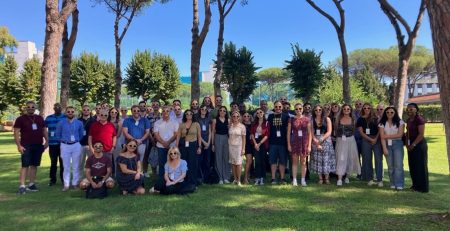







Acea Run Rome the Marathon 2026: World Athletics and Sapienza University deliver a multi-platform air quality monitoring campaign along the racecourse
Rome, Italy | 22 March 2026 — During the Acea Run the Rome Marathon on 22 March 2026, an integrated atmospheric and air quality monitoring campaign was delivered through a collaboration between World Athletics, the organisers of Acea Run Rome The Marathon and Sapienza University of Rome (Department of Physics and Department of Physiology and Pharmacology “V. Erspamer”).
The campaign combined static monitoring at the finish area with dynamic monitoring on the racecourse, reflecting the organisers’ request for both fixed-site and in-motion measurements during race operations. Monitoring was conducted on race day and, in the days preceding the event, with static systems deployed to establish baseline conditions and enable comparison with race-day exposure.
For Sapienza’s Department of Physics, the monitoring activities were delivered in collaboration with Serco within the BAQUNIN project (Boundary-layer Air Quality analysis Using Network of Instruments; www.baqunin.eu), funded by the European Space Agency (ESA) and EUMETSAT. This positioned the Rome Marathon campaign within a broader framework of advanced environmental observation and research.
A multi-sensor network along the route and on official vehicles
To ensure spatial coverage along the marathon corridor, the partnership deployed a network of fixed sensors at selected points on the racecourse, alongside mobile monitoring systems operating during the race. Additional devices were installed through Sapienza University’s cross-department collaboration, with instruments positioned along the route and on official vehicles moving on the course. The combination of static and mobile platforms enabled the capture of spatial and temporal variation in air quality across the event footprint.
Sensors recorded key parameters including particulate matter, gaseous pollutants and meteorological variables, generating a dataset designed to support both operational understanding and future scientific analysis.
Supporting athlete and public health in urban sport environments
By integrating research-grade monitoring with the delivery of a major mass-participation road race, the initiative aimed to improve understanding of environmental conditions experienced by athletes, staff, spectators and the broader city environment during competition. The resulting data will undergo further analysis and may contribute to future work on physical activity and air quality in urban settings, as well as strategies to support health protection and risk communication at major events.
This campaign builds on World Athletics’ wider commitment to environmental responsibility and evidence-based risk management in sport, and demonstrates how major events can serve as platforms for innovation, knowledge generation and inter-institutional collaboration.
“Through air quality monitoring and its long-term commitment, the Health & Science Department wants to facilitate decision-making to improve air quality during the world’s most important sporting events, as air quality is a key factor in achieving sporting goals and has a direct impact on athletes’ health.”
Frédéric Garrandes, Scientific Senior Manager, Health & Science, World Athletics
“Sustainability is not an add-on for us, but a core element of how we deliver the Acea Run Rome the Marathon. Over the years, we have implemented many initiatives in this area, and this monitoring campaign represents a further, concrete and innovative step forward in our journey. It demonstrates how the Acea Run Rome the Marathon continues to be a pioneer on these topics, bringing together sport, research and environmental responsibility. I would like to thank World Athletics for their commitment, collaboration and support in making this project possible.”
Lorenzo Benfenati, Project Manager & Race Director Acea Run Rome the Marathon
“Bringing air-quality research into a major event like the Rome Marathon transforms the city into an open-air laboratory, allowing us to study how pollutants vary under dynamic conditions and intense human activity. The data collected will provide valuable insights into people’s actual exposure to these substances and support the development of increasingly effective strategies to protect public health. This monitoring activity is part of the BAQUNIN project, which integrates ground-based and satellite observations to advance our understanding of air quality, generating essential data for research and for future applications that benefit everyone’s health.”
Annalisa Di Bernardino, Tenure-Track Assistant Professor, Department of Physics, Sapienza University of Rome, on behalf of the BAQUNIN team
Media contacts
World Athletics (Health & Science Department): Frédéric Garrandes, frederic.garrandes@worldathletics.org Sapienza University: Prof. Annalisa Di Bernardino, annalisa.dibernardino@uniroma1.it Run Rome The Marathon: Alexander Craig Sause, alexander.craig@infrontsports.com